 Douro Valley Wine Tour
Douro Valley Harvest Season Guide: Grape Picking, Foot-Treading and September-October Tours
The Douro Valley harvest season, the vindima, runs from late August into October, and it is the only stretch of the year when the terraces are actually being worked. This guide compresses the timing by grape variety, the foot-treading tradition, the estates that take visitors and every booking window that matters, so a September or October trip lands inside the action instead of watching it from the road.
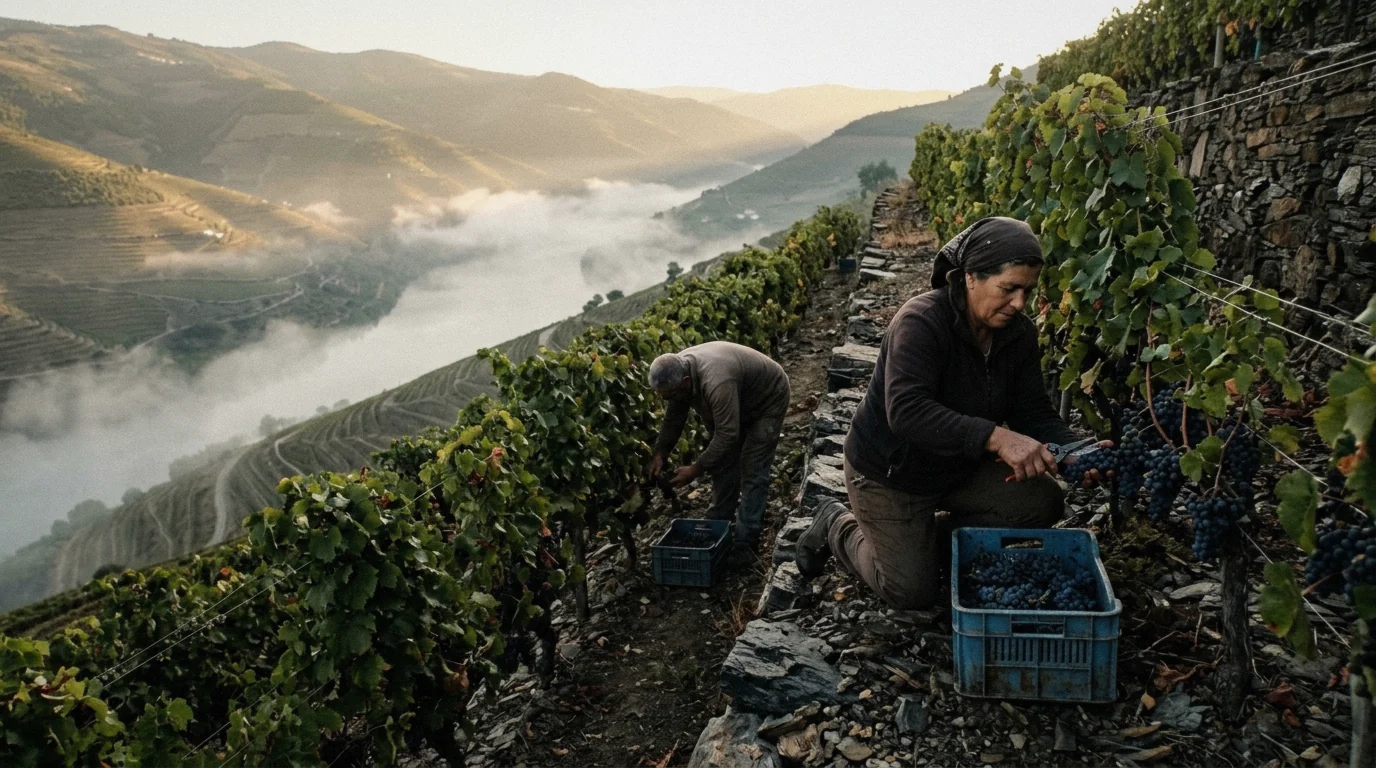
Dawn picking, the first shift of the Douro Valley harvest season.
Quick answer The vindima in one paragraph, with the booking windows that matter
The Douro Valley harvest runs from late August through October, peaking mid-September to early October when the red varieties come in. Days follow a fixed rhythm: picking from dawn to about 11:00, sorting through the afternoon, and foot-treading in granite lagares in the evening. Whites are picked first, late August into early September, and late-harvest parcels can stretch into November. Book harvest experiences 4 to 8 weeks ahead and Pinhão rooms 2 to 3 months ahead. The wider calendar sits in the best-time guide, and the tour lineup shows the days that run in the window.
Key takeaways
- Whites, Rabigato, Viosinho, Gouveio and Malvasia Fina, come in late August to early September. Reds, Touriga Nacional, Touriga Franca and Tinta Roriz, peak mid-September to early October
- Foot-treading evenings run from about 18:30 to midnight, and early to mid-October has the most sessions
- Price benchmarks for estate harvest experiences: Quinta do Panascal at roughly $60-100 up to Quinta do Vallado at $250-400
- Booking lead times: organized tours 2-4 weeks, estate visits 1-2 weeks, foot-treading 4-8 weeks, rooms 8-12 weeks
- Getting there during harvest: train from Porto in 2.5-3 hours at 12-15 EUR one way, rental car 30-50 EUR per day plus tolls. The route details are in the DIY guide
When the Harvest Actually Happens
The Douro has no single harvest date. Steep slopes, mixed microclimates and dozens of varieties stretch the picking across nearly three months, and the exact dates shift every year with the weather. The table below is the pattern the region follows in a normal year.
The calendar by grape variety
Variety and altitude set the order. Higher vineyards ripen later, south-facing slopes earlier, and winemakers pick on sugar, acidity and tannin rather than on the calendar. Whites go first to protect their acidity, thick-skinned reds last because they need full ripeness.
| Grape group | Typical window | Goes into | What it means |
|---|---|---|---|
| Whites: Rabigato, Viosinho, Gouveio, Malvasia Fina | Late August to early September | Douro white DOC wines and white port | Picked first to preserve acidity, morning picking essential |
| Reds: Touriga Nacional, Touriga Franca, Tinta Roriz, Tinta Barroca | Mid-September to early October | Douro red DOC wines, ruby and tawny port | The peak period, when lagares and picking crews run at full tilt |
| Late-harvest parcels: select Touriga Nacional, old-vine Tinta Roriz | Mid to late October | Vintage port and LBV | Extended hang time concentrates sugar, with rain risk attached |
A harvest day at a quinta
The daily rhythm barely changes across the season, and knowing it tells you where to be and when.
- 05:30: pickers leave for the vineyards with headlamps, because heat ruins acidity and starts premature fermentation
- 10:00: first grape loads reach the winery
- 12:00: the workers' harvest lunch, the meal the region's cuisine is built around
- 14:00: afternoon picking shift, weather permitting
- 18:00: final delivery, sorting complete
- 20:00: foot-treading begins in the lagares
- 22:30: treading winds down and the wine settles overnight
Late August: the quiet before
Days of 25-35°C, dust on the access roads, winemakers running daily sugar tests and white varieties showing the first colour change of veraison. Nothing is picked yet, which is exactly the appeal: intimate vineyard tours while winemakers explain ripeness decisions, tastings of previous vintages, low crowds and river levels still right for cruising. It is also the moment to lock in September and October positions, since harvest tours book 6-8 weeks out.
September: whites, then the reds begin
The first half of the month belongs to the whites, picked from 05:30 and pressed immediately to keep the aromatics. In the second half the famous red varieties start coming in, crews swell, lagares get filled and the first treading sessions of the season run. Days sit at 20-28°C with the landscape starting its turn toward autumn.
Village harvest festivals, the Festa das Vindimas, run through the month. Peso da Régua hosts the large-scale version with concerts and tastings, Pinhão celebrates riverside with rabelo boat parades, and the smaller villages keep things family-scale with folk music, street markets and grape-blessing ceremonies at the churches.
October: peak treading and the colour turn
This is the crescendo. Every quinta works at capacity, lagares fill nightly and some estates run open-lagar evenings where visitors join on the spot. Red varieties reach optimal ripeness, sorting tables run dawn to dusk and the terraces turn gold, rust and amber, with a lower sun stretching golden hour past two hours. Days of 15-23°C, sunset near 19:00.
The food calendar turns with it: chestnuts arrive from street vendors and in soups, wild mushrooms from the autumn rains, game stews as hunting season opens. Late in the month some estates pour vinho novo, new wine still cloudy and faintly fizzy from fermentation, low in alcohol at 10-12% and never bottled. Peso da Régua's harvest fair lands mid-October and Pinhão runs a costumed vindima procession to the river.
Early November: after the press
The harvest finishes and the cellars take over: fermentation visible in tank tours, bubbling tanks and sweet-yeasty air in the adegas, early barrel tastings of the new vintage. Days cool to 10-18°C with more rain, the olive harvest starts on some estates with new oil to taste, and on November 11 the São Martinho festival brings roasted chestnuts and água-pé, partially fermented must at about 5-8% alcohol. Quieter, cheaper and more intimate than the harvest weeks, with the winemakers finally free to talk.
Foot-Treading: What Actually Happens
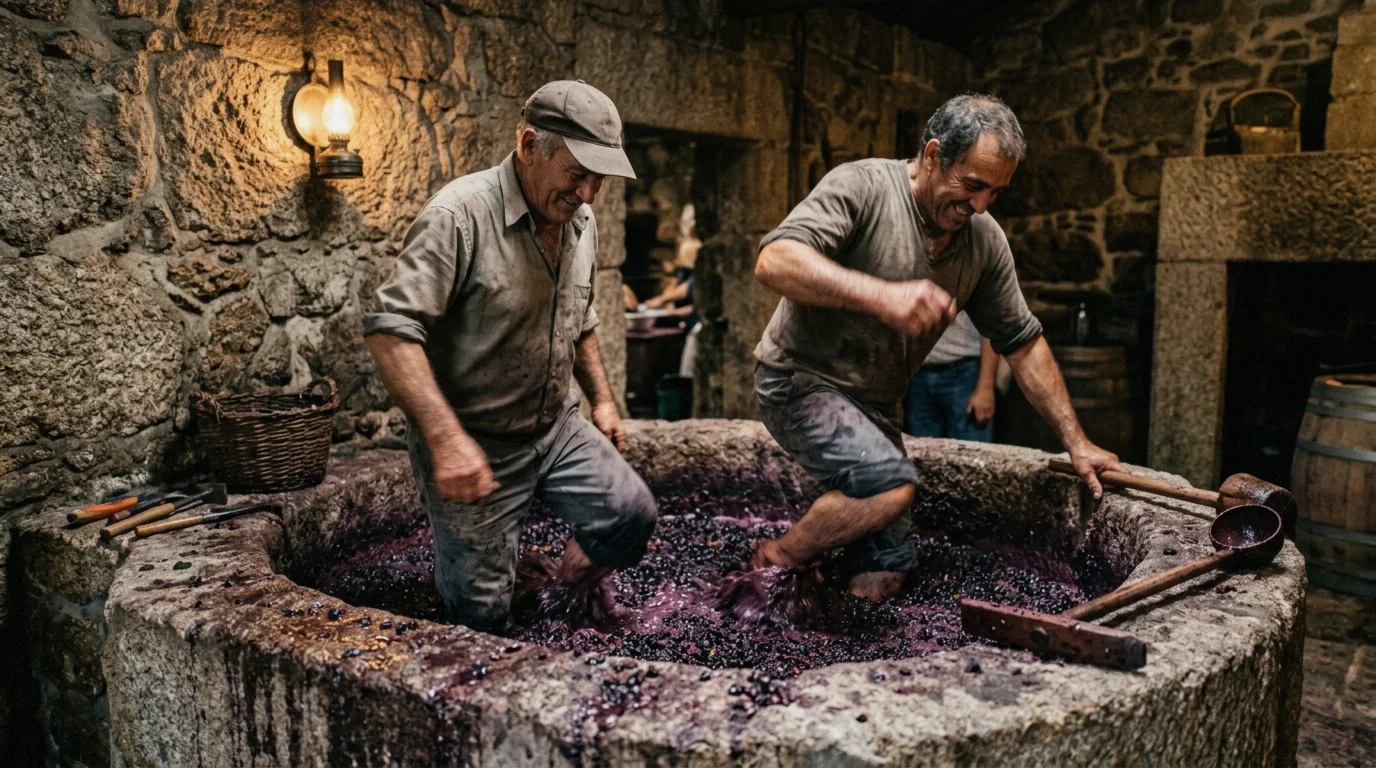
Foot-treading, pisa a pé, is not a show laid on for tourists. Premium port producers still tread their best grapes because feet crush without splitting the bitter seeds, extract colour from the skins evenly and warm the must enough to start fermentation naturally. The Douro wine region has held UNESCO World Heritage status since 2001, and this tradition inside it is the part visitors can still join.
The evening, hour by hour
Estate programs differ in the details, but the published schedules for visitor treading nights follow the same skeleton, running from aperitif to certificate across about five hours.
| Time | What happens | Duration |
|---|---|---|
| 18:30 | Arrival, welcome drink, estate introduction and safety briefing | 30 min |
| 19:00 | Winery tour: barrel rooms, fermentation cellar, the estate's ports aging | 45 min |
| 19:45 | Traditional multi-course dinner with wine throughout | 60-90 min |
| 21:15 | Change into shorts, wash feet at the stations, technique briefing | 15 min |
| 21:30 | Phase one, the Corte: organized rhythmic treading in parallel lines | 60-90 min |
| 23:00 | Phase two, the Liberdade: music and free dancing in the must | 30-45 min |
| 23:45 | Taste the freshly trodden mosto, wash up, photos, participation certificate | 30 min |
The two phases
A lagar is a shallow granite tank holding 2 to 4 tons of grapes, and a working one needs 20 to 30 people.
The Corte is the work. Participants form parallel lines, link arms and stomp in unison behind a leader's rhythm, cutting through the grape mass so every cluster gets equal pressure. The first ten minutes the grapes are cool and firm. By twenty they are ankle-deep in warm must. By sixty the job is mostly done.
The Liberdade is the celebration: accordion and guitars, folk songs taught call-and-response, and free dancing in the must until the winemaker is satisfied with the consistency. Purple-stained legs to the knee are the standard souvenir.
Who can do it
The honest demand: standing and moving continuously for 90 to 120 minutes in slippery must, comparable to water aerobics or a long brisk walk. Most healthy adults finish without trouble and feel it in their legs the next day.
Working lagares usually require participants to be 18 or over because of the alcohol environment and the late hours. Some estates run family sessions from age 12 with grape juice instead of wine, and a few keep play lagares for children. It is not suitable in pregnancy, with heart conditions, with open cuts on the feet, or with serious balance or mobility limitations.
What to wear and bring
Grape juice stains permanently, and that fact drives the whole packing list.
- Old shorts and an expendable t-shirt or tank top, both headed for the bin afterward
- Flip-flops or sandals for before and after, plus closed-toe shoes if the evening includes a cellar tour
- A large towel and a plastic bag for the wet, stained clothes
- A complete change of clothes, packed separately
- A hair tie for long hair, baby wipes for quick cleanup, and a water bottle, because treading is thirsty work
Etiquette in the lagar
You go completely barefoot in the lagar, no exceptions, since lotions and foot oils contaminate the wine. Jewelry stays behind, for the wine's sake and because things dropped in the must stay lost. Wash feet thoroughly at the stations provided, tie back long hair, follow the leader's rhythm and pace yourself, stepping out briefly is fine.
The frame to keep: this is real winemaking for commercial sale, not a wine-themed park. Ask before photographing the workers, respect no-flash zones in the cellars and thank the crew. If you photograph extensively, a 10-20 EUR tip for the pickers is the appreciated norm.
The Estates That Take Visitors During Harvest
Not every quinta opens its harvest to visitors, and the ones that do differ enormously in format and price. The table compares the estates that actively welcome visitors during vindima, with their published booking lead times and price ranges for the harvest experience.
Side by side
Price bands are per person for the harvest experience, from estate and platform listings. Lead time is what each estate asks for, and in practice the busy September weekends consume all of it.
| Quinta | Location | Harvest experience | Book ahead | Price range | Best for |
|---|---|---|---|---|---|
| Quinta do Bomfim | Pinhão | Picking, winery tours, evening treading in September and October | 2-4 weeks | $150-200 | Serious wine enthusiasts, a Symington estate making vintage port in lagares |
| Quinta da Roêda | Pinhão | Full harvest day, treading for private groups only | 4-6 weeks | $200-300 | Luxury travellers, the historic Croft estate |
| Quinta do Crasto | Gouvinhas | Picking, vineyard lunch, treading on select dates | 2-3 weeks | $120-180 | Photographers, terraces dropping straight to the river |
| Quinta de la Rosa | Pinhão | Picking, boat from the pier, evening treading | 2 weeks | $100-150 | Overnight stays, boutique hotel on site |
| Quinta do Panascal | Valença do Douro | Group picking and communal treading, first-come sessions | 1-2 weeks | $60-100 | Budget travellers and families, relaxed format |
| Quinta do Vallado | Peso da Régua | Premium dinners, private treading for up to 8, reservation only | 4-8 weeks | $250-400 | Wine collectors, an estate founded in 1716 |
| Quinta Nova | Covas do Douro | Harvest workshops inside select packages | 4-6 weeks | $300+ | Five-star stays with the harvest attached |
Tourist lagar or working lagar
One distinction separates the authentic from the theatrical. Some estates, especially the budget-friendly ones, keep separate tourist lagares, with grapes that may go into entry-level wines or not get bottled at all. Premium estates such as Bomfim and Roêda put visitors into the actual lagares producing commercial vintage port, which is why they enforce strict hygiene and cap numbers.
The sorting question costs nothing: ask directly when booking, will we be treading grapes used for your commercial wines? What the grapes become afterward is its own subject, covered in the wine guide.
Mobility limits and the alternatives
Harvest participation is physical, but the season is watchable without it. Cellar tours show fermentation in progress with minimal walking, viewpoint stops look down on working pickers, boats pass the vineyards at water level, and restaurant harvest menus pair the new wines. Quinta Nova has modern facilities with elevators and paved paths, Vallado runs a single-level tasting room and restaurant, and most boat-plus-tasting days involve little walking.
September or October?
If You want the best weather with the harvest running
Mid to late September. Days of 20-28°C, low rain, white grapes in and the red harvest building.
If Foot-treading is the priority
Early to mid-October. Lagares fill nightly and nearly every estate with a lagar runs sessions.
If You want fewer people around
Late August or the first week of September, before the crowds and before the peak prices.
If Autumn photography is the goal
Mid to late October, when the colour peaks and the low sun stretches the golden hour.
If You want new wine and chestnuts instead of picking
Late October into early November, for vinho novo tastings, fermentation cellars and São Martinho approaching.
Getting There and Staying During Vindima
Harvest changes the transport math. Harvest trucks own the roads mid-morning, evening trains fill, and the valley's small hotel stock sells out months ahead. The figures below are the published costs for the season.
Four ways in
The same four transports serve the valley year-round, priced here for the harvest window with the seasonal frictions noted.
| Option | Cost | Time | What it means |
|---|---|---|---|
| Rental car | 30-50 EUR per day, plus 15-20 EUR tolls and fuel | 1.5-2 hours to Régua, 2-2.5 to Pinhão | Most flexible, needs a sober driver, roads busiest 09:00-11:00 with harvest trucks |
| Train from Porto | 12-15 EUR one way, 20-25 EUR return | 2.5-3 hours, 3-4 departures daily | Scenic and car-free, no air-conditioning on older stock in September heat |
| Organized tour | $80-110 budget, $100-150 small group, $150-300+ private | Full day | Harvest access without logistics, group sizes from 6-12 down to private |
| Private driver | 200-350 EUR for 8-10 hours, up to 7 passengers | Door to door | Everyone drinks, cost splits best across 4-6 travellers |
The walkable estates and the road reality
From the rail line, three estates work on foot: Quinta de la Rosa about 15 minutes from Pinhão station and Quinta do Bomfim about 20, with Quinta do Vallado roughly 10 minutes from Régua station. Pinhão's taxi stand covers the rest.
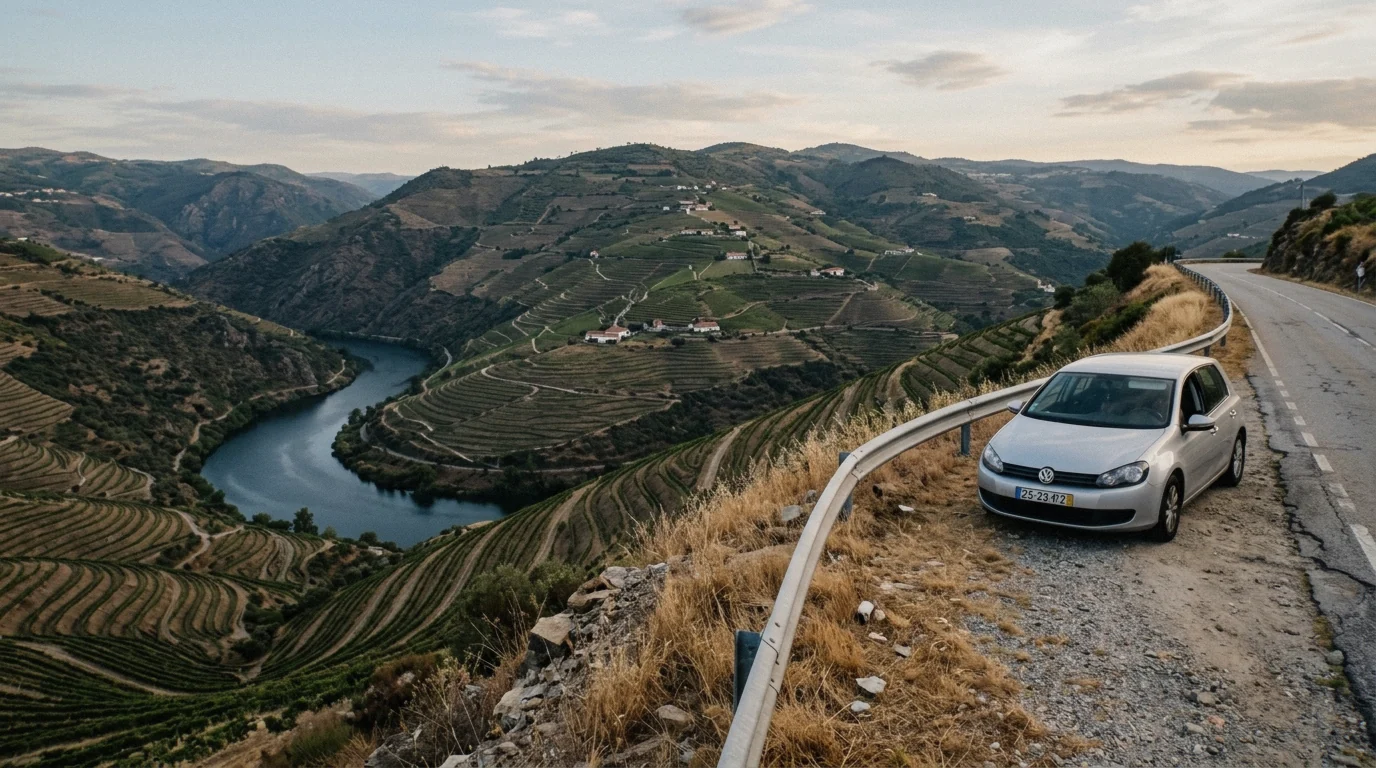
Driving in September and October, two adjustments matter. Add 50 to 100 percent to any GPS estimate, because narrow roads, slow harvest trucks and viewpoint stops all conspire. And start early, because the roads run busiest between 09:00 and 11:00 when the trucks move. Book an automatic transmission if that is what you drive, and download offline maps, since cell service drops in the valleys.
Rooms: the 2-3 month rule
September and October are the valley's peak season, and accommodation should be booked 2-3 months ahead, with late-September and early-October weekends going first. Published benchmarks for the season: The Vintage House in Pinhão runs 200-350 USD a night, Quinta de la Rosa 180-280 with breakfast on the terrace, Casa de Casal de Loivos 120-180 with the valley-view pool, LBV House 100-150 riverside, and Residencial Ponto Grande 60-90 as the simple budget pick. In Régua, Hotel Régua Douro sits at 90-140 and Casa Belas Artes at 80-120.
Staying at a wine estate is the immersive version: Quinta do Vallado at 200-350 a night with breakfast from the estate's own olive oil and jam, Quinta Nova at 300-600 with the spa and the vineyard views, and Quinta de la Rosa at 180-280 with only eight rooms. Ask any hotel about harvest packages, a river-view room costs little more, and packed breakfasts for early estate starts are a normal request.
Booking lead times, compressed
Every harvest booking has its own clock, and the windows do not overlap neatly. This is the timeline that works.
| Experience | Book ahead | Why |
|---|---|---|
| Organized tours | 2-4 weeks | Popular dates sell out first |
| Estate visits without treading | 1-2 weeks | Weekends fill fastest |
| Foot-treading sessions | 4-8 weeks | Lagar space caps at 20-30 people |
| Private estate experiences | 6-12 weeks | Staffing, menus and access planned around your group |
| Accommodation | 8-12 weeks | Peak season, the best properties book earliest |
Booking estates directly
Estate emails get answers in 2 to 5 business days, slower than any booking platform, and a follow-up call after a week of silence is normal practice, with English-speaking staff at most of the larger quintas. A 50 percent deposit is common, cancellation terms are often stricter than platform bookings with 72-hour notice typical, and dietary restrictions must be flagged at booking because estates source to order.
The day before, call or message to confirm, and ask the only question that matters: are you picking tomorrow, and will the treading happen? A warm year can finish the harvest by early October and a cool one stretch it to the month's end, so estates follow their own calendars. Their social feeds usually post the current picking status in real time.
Which Guided Days Fit September and October
Most guided days run year-round, but harvest rewards a specific format, and the marketing language needs decoding before anything gets booked.
What a harvest-appropriate tour looks like
The word harvest appears in plenty of listings that include no picking and no treading, just vineyard visits and tastings with a seasonal label. The phrases that mean the activities are real: grape picking, foot-treading, pisa a pé, lagar experience.
Beyond the wording, the format that suits vindima has three traits. A flexible itinerary the guide can bend toward whatever the estates are doing that day. A lunch at an estate rather than a restaurant. And a small group, because a 25-seat coach cannot detour to watch a crush pad in action.
Where to start in this lineup
Among the days compared on this site, the 10-wine open-fire farm lunch tour is the closest harvest fit, with ten wines across two estates and the kind of open-fire farmhouse lunch the season's food calendar is built around. The 9-tastings small-group day keeps the group at eight, which is what makes spontaneous harvest stops possible. The full comparison lines up all sixteen listings by price, group size and route.
Estate-run picking and treading programs, the ones in the table above, book separately and directly, and they stack neatly with a guided day: tour on one day, lagar evening at a quinta on the next.
What It Costs, Three Ways
Harvest pricing spans a tenfold range depending on how much is booked and where the nights are spent. Three published budget shapes cover the spread.
The one-day budget version, about 150 EUR
The published budget-day build: 50 EUR for a room, 5 for café breakfast, 10 for a picnic from a Pinhão grocery, about 70 for the Quinta do Panascal group experience with picking, treading and lunch included, and 15 for dinner at a village tasca.
The discounts that keep it under 100 EUR a day: midweek rooms run 20-30 percent cheaper from Monday to Thursday, trains booked about 8 days ahead pick up early-bird fares, estates sell bottles 10-20 percent under tourist-shop retail, and the village cafés' set lunches cost 8-12 EUR against double that riverside.
The classic three-day, two-night trip, 260-450 EUR per person
The first-timer shape from the published itinerary: two nights in Pinhão at 100-200 EUR, a full-day guided tour at 100-150 USD, 40-60 EUR for meals outside the tour, and 20-40 EUR for one extra estate visit.
The shape: arrive and catch sunset at the Casal de Loivos viewpoint above Pinhão, spend the middle day on the guided harvest circuit of wineries, lunch and cruise, then a relaxed morning at a walkable estate before the scenic road back toward Porto.
The premium estate version, 1,250-2,250 EUR per person
The published premium build: three nights at a wine estate for 600-1,200 EUR, a private transfer at 200-300 EUR, estate experiences at 300-500 EUR, and 150-250 EUR for additional meals and tastings.
What the money buys: a 06:00 start with the picking crew, a worker's breakfast in the vineyards, time with the winemaker rather than a guide, evening treading capped at eight guests and access to wines that never reach retail shelves. Book this tier directly with the estates, 6 to 12 weeks out per the lead-time table above.
Weather and Packing for the Vindima
September and October sit either side of a real weather shift, and the packing list changes with it. The figures are published norms for the valley.
The numbers
The two harvest months sit on opposite sides of autumn. September behaves like late summer and needs sun protection plus a light layer for the evening; October behaves like autumn and needs waterproofs and warmth for the early-morning vineyard visits. Figures are typical valley values rather than a forecast, so check the national weather service the week you travel.
| Measure | September | October | What it means for the day |
|---|---|---|---|
| Daytime | 20-28°C | 15-23°C | T-shirt weather either month, layer by October |
| Nights | 12-16°C | 8-12°C | Warm layer for dawn pickups |
| Rainy days | 2 to 4 | 5 to 7 | Pack a shell in October |
| Daylight | About 12.5 h | About 11 h | Earlier sunsets shorten the cruise light |
| Sunrise / sunset | 07:15 / 19:45 | 07:45 / 18:45 | Harvest photo light is early in October |
The pack list
- September: light layers, comfortable walking shoes for uneven vineyard ground, hat, sunglasses, SPF 30+, a light rain jacket
- October: warmer layers and a sweater, a proper waterproof jacket, closed waterproof shoes, a scarf for chilly mornings
- For treading specifically: the staining kit from the foot-treading section, old shorts, expendable shirt, towel, flip-flops, plastic bag, full change of clothes
If it rains on the harvest day
Light rain changes little, and mist over the terraces photographs well. Heavy rain is different: picking can be cancelled, because wet grapes dilute the wine, and boat cruises may stop for safety, but foot-treading continues, since it happens indoors. Tours adapt with more cellar time and longer tastings.
On cancellations: platform tours usually reschedule or refund if the operator cancels, while direct estate bookings follow the estate's own, stricter terms. Book rates with free cancellation to 24 hours where possible, watch the 3-day forecast and reschedule ahead of any major storm.
Harvest Season Questions
Can I pick grapes and stomp them on the same day?
Yes. Some private harvest days combine morning grape picking with an evening foot-treading session, and some estates sell the two as one package. Confirm at booking that both activities are in the program, since many listings advertise harvest while including neither. Wear clothes that survive permanent stains, closed shoes for the vineyard and flip-flops for the lagar.
Will I really be making wine that gets sold, or is it just for tourists?
Both exist. Some estates tread in separate tourist lagares, with grapes headed for entry-level wines or nowhere at all. Premium estates such as Quinta do Bomfim and Quinta da Roêda put visitors into working lagares producing commercial vintage port, which is why hygiene rules there are strict. The sorting question: will we be treading grapes used for your commercial wines?
Can children take part in the Douro harvest?
By activity. Grape picking usually starts at age 8 with a parent. Working lagares are 18 and over, because of the alcohol environment and the late hours. Some estates run family treading sessions from age 12 with non-alcoholic grape juice, and Quinta do Panascal is the family pick, with picnic areas and a relaxed format. Estate visits without treading welcome all ages.
How much wine do you actually drink on a harvest day?
Across a full day, roughly 8 to 12 small tastings plus 2 to 3 glasses with meals: a welcome glass, three or four pours at each of two wineries, wine at lunch and often a port on the boat. Spread over 8 to 10 hours with food, that is about a bottle. Tell the guide to pour smaller if needed, use the spittoon without embarrassment and alternate with water.
Can vegetarians eat the harvest lunch?
Yes, with advance notice. Traditional harvest meals lean heavily on meat, caldo verde soup, cozido stew, roasted lamb and pork, but estates can provide vegetable-based menus, cheese plates and salads when told at booking. Vegan is harder, since Portuguese country cooking relies on dairy and eggs, and small family quintas cope less well than large estates or organized tours. Never spring it on them on the day.
Can I buy wine at the estates and ship it home?
Yes. Cellar-door prices run 10-20 percent under retail, most estates take cards and provide boxes. Shipping inside the EU costs about 20-40 EUR a case and arrives in 1-2 weeks. Shipping to the US is state-dependent: some states prohibit direct shipments, some estates lack export licenses, and third-party shippers charge roughly 80-150 EUR a case over 4-8 weeks. Carrying bottles home, wrap them and pack them in the suitcase centre.
What if the harvest is already finished when I arrive?
Dates shift every year, so late-October visits can find picking done while the rest of the season runs on: treading evenings at estates that still have grapes, fermentation cellar tours with the tanks actively bubbling, and from early November, barrel tastings of the new vintage plus the olive harvest. Confirm status with the estates 1-2 weeks before travelling, and check their social feeds for real-time picking updates.